
Taking kids to places and activities that build their brains and broaden their outlook is among the most fun parts of parenting, in my book. From science museums to library events, there are so many fun adventures to have with your child that will shape them for life. And one underrated enrichment activity that should make your list is literary tourism.
Visiting sites related to children’s authors and books can build or reinforce excitement around reading (and even make a child want to author their own works!)—as well as create a valuable opportunity for learning, conversation, and bonding.
There are many historic literary sites open to the public, including authors’ homes and other spots. There are also a variety of other places with special homages or connections to specific writers and literature. This list rounds up some of the U.S. sites associated with authors of books for children and teens, to help you plan your own literary adventures with your family.
You can also do your own research to find locations close to your home or related to your family’s favorite books or authors. Consult the American Library Association’s literary landmarks list, the nonprofit Author Adventures site, the National Register of Historic Places, and library or bookstore events calendars for ideas.
Before you start, check out these tips for successful literary tourism with kids.
Literary Tourism Sites for Families
Below is a sampling of U.S. sites associated with various children’s and middle-grade authors (compiled in part from the ALA’s wonderful list, along with other resources). It’s organized by author name, followed by the title of one of their best-known works for young readers.
Tip: Be sure to check details ahead of time to confirm which sites are open to the public—some can only be viewed from outside—as well as visiting hours and whether reservations may be needed. Call ahead if you can, because sites periodically close for renovations (or even shut down altogether, like the former cottage of children’s poet Robert Frost, which was a museum until it closed permanently for lack of funds).
Children’s Author and Book Tourist Sites
Louisa May Alcott, Little Women
- Orchard House in Concord, Massachusetts is both the setting for Alcott’s 1868 Little Women and where she wrote the novel. The house, originally built about 1650, is now a museum open to the public, with guided tours and information about the members of the real-life Alcott family and how they influenced the fictional characters.
Maya Angelou, I Know Why the Caged Bird Sings
- This walking tour itinerary through Stamps, Arkansas, where Angelou lived as a child, shows places the author would have known. It includes locations mentioned in her classic memoir and other sites that would have been familiar landmarks.
- In St. Louis, Missouri, you can see the author’s birthplace and first home in a neighborhood that was segregated at the time. The house is now an official city landmark.
- In New York, you can walk by the Harlem house that Angelou renovated and occupied part-time later in her life. The house is privately owned.
Lydia Maria Child, Over the River and Through the Woods
- Child was an abolitionist writer known in the 1800s for promoting the rights of Indigenous Americans, enslaved people, and women. These days, she’s remembered for the 1844 Thanksgiving poem usually called “Over the River and Through the Woods.” The Grandfather’s House Historical Marker in Medford, Massachusetts marks the real-life house from the poem, where the author’s grandparents lived. Growing up, Child would visit this site from her home on the other side of the river. The original house is still there, although it was enlarged later in the 1800s.
Louise Erdrich, Birchbark House
- Birchbark Books in Minneapolis is an independent bookstore owned by Louise Erdrich and focused on Native American literature. A unique, eco-friendly space, it features plenty of fun for kids: a selection of children’s books, a birchbark children’s loft, hand-stuffed chairs for kids, a hobbit hole reading nook, and a handmade wooden canoe hanging from the ceiling. There are also rotating displays of works by Native American artisans—and Louise Erdrich will sign or personalize any of her books ordered through the bookstore, according to the website. Check ahead for special events.
Marguerite Henry, Misty of Chincoteague
- Henry’s middle-grade fiction features the wild ponies of Assateague Island on the Maryland-Virginia border. Wild ponies really have lived there for hundreds of years, likely descended from survivors of a Spanish shipwreck. Spectators can watch the annual pony swim, when “saltwater cowboys” herd the ponies through the water from their island home to the nearby Chincoteague Island.
Zora Neale Hurston, Their Eyes Were Watching God
- The Moseley House in Eatonville, Florida was the home of Hurston’s childhood best friend, and the author often stayed there. It holds a museum with memorabilia of the town, which featured heavily in Hurston’s work.
- The Hall Branch of the Chicago Public Library in Illinois was a meeting place for black literary giants including Hurston, as well as Langston Hughes, Gwendolyn Brooks, Richard Wright, and many others.
- Idlewild, Michigan was a vacation spot favored by Hurston, Hughes, and W. E. B. DuBois. The Idlewild Public Library has a literary landmark dedicated in their honor.
Ezra Jack Keats, The Snowy Day
- Prospect Park in Brooklyn, New York features a bronze statue of Keats’s characters Peter and Peter’s dog, Willie, in the park’s Imagination Playground. Keats evoked the Brooklyn neighborhood where he grew up in the award-winning picture books that he wrote and illustrated.
Harper Lee, To Kill a Mockingbird
- The Monroe County Museum in Alabama has an exhibit about Harper Lee and To Kill a Mockingbird. It includes photos, memorabilia, and a documentary about Monroeville—the author’s hometown and inspiration for her fictional setting—during the 1930s.
Jack London, The Call of the Wild
- The author’s ranch in Glen Ellen, California has been preserved as the Jack London State Historic Park. Visitors can tour numerous buildings, including the cottage that London bought in 1911 and where he wrote many of his later works, as well as explore the grounds and hiking trails.
Maud Hart Lovelace, Betsy-Tacy
- The homes of the author and her best friend in Mankato, Minnesota serve as key settings in Lovelace’s autobiographical historical novels. Both are open to the public with prior reservation, offering a window into early-twentieth-century life and the books’ fictional world.
Robert McCloskey, Make Way for Ducklings
- The Boston Public Garden in Massachusetts was the setting for McCloskey’s 1942 Caldecott Medal picture book Make Way for Ducklings and now features a bronze statue of the duckling family.
- Hamilton Lane Library in Hamilton, Ohio, was a childhood haunt of the author, who was born in Hamilton and whose first book featured scenes set around town, including at the library.
A. A. Milne, Winnie-the-Pooh
- The New York Public Library is home to the original Winnie-the-Pooh teddy bear, along with Eeyore, Tigger, Piglet, and Kanga. The stuffed animals belonged to Christopher Robin Milne, the author’s son, and inspired the iconic characters.
Toni Morrison, Peeny Butter Fudge
- The Toni Morrison Reading Room at the main library in Lorain, Ohio, where Morrison grew up, celebrates the Nobel Prize-winning author. It houses a collection of her writings, complete with her works for adults and the lesser-known children’s books Morrison co-authored with her son Slade. A glass wall is etched with an excerpt of Morrison’s Nobel Prize for Literature acceptance speech.
- Look for the historical marker in front of Lorain’s Carnegie Center, formerly a library, where Morrison once worked, too. It now houses the Lorain Historical Society—pop inside to get a peak at what Lorain was like in years past.
Walter Dean Myers, Monster
- The award-winning author and former National Ambassador for Young People’s Literature grew up checking out books from the George Bruce Branch of the New York Public Library. The library put up a plaque to the author dedicating it as a literary landmark in 2015.
Marjorie Kinnan Rawlings, The Yearling
- Marjorie Kinnan Rawlings’ house in Cross Creek, Florida, is now a state park, preserved as it was when she lived there in the 1930s. This was where Rawlings lived when she wrote her Pulitzer prize-winning 1938 novel The Yearling, and Cross Creek provides the setting for the book.
Woodrow Wilson Rawls, Where the Red Fern Grows
- Rawls grew up on his mother’s Cherokee land allotment in the hills around Tahlequah, Oklahoma. The town now hosts an annual Red Fern Festival with all-ages activities, including children’s games, a rubber-duck race on a creek, a coon dog field trials event, and a Miss Red Fern Pageant.
Dr. Seuss, The Cat in the Hat
- Visitors to Springfield, Massachusetts, the birthplace of Theodor Seuss Geisel, aka Dr. Seuss, can visit the Dr. Seuss National Memorial Sculpture Garden and The Amazing World of Dr. Seuss Museum. The museum contains exhibits in English and Spanish and encourages word play, including rhyming games, making up stories, and prompts to experiment with new sounds and vocabulary.
Gene Stratton-Porter, Freckles
- A pioneering naturalist and popular writer, Stratton-Porter documented the unique “limberlost” swamp ecosystem of Indiana and brought it to life dramatically in her fiction—even as it was rapidly disappearing in real life. Generations after her death, her work inspired nature-lovers to restore a portion of the lost habitat. Now, visitors can see it for themselves at the Limberlost State Historic Site, as well as visit Stratton-Porter’s lakeshore cabin at Wildflower Woods.
Hildegarde H. Swift, The Little Red Lighthouse and the Great Gray Bridge
- The lighthouse celebrated in Swift’s 1942 children’s book is no longer functioning, but fans worked to save it as a historic landmark. It’s now part of the Historic House Trust of New York City and visitors can see the beloved lighthouse in Manhattan’s Fort Washington Park.
Kay Thompson, Eloise
- Fans of Thompson’s 1955 picture book can visit the historic Plaza Hotel in New York, the real hotel that served as the setting for the fictional Eloise. Visitors can have afternoon tea in the Palm Court, shop for a wide variety of Eloise-themed products in the Plaza Boutique, and put a message for Eloise into a special mailbox. Those who want to go all out (and drop a small fortune) can even book a stay in a special pink Eloise hotel room.
Mark Twain, Tom Sawyer
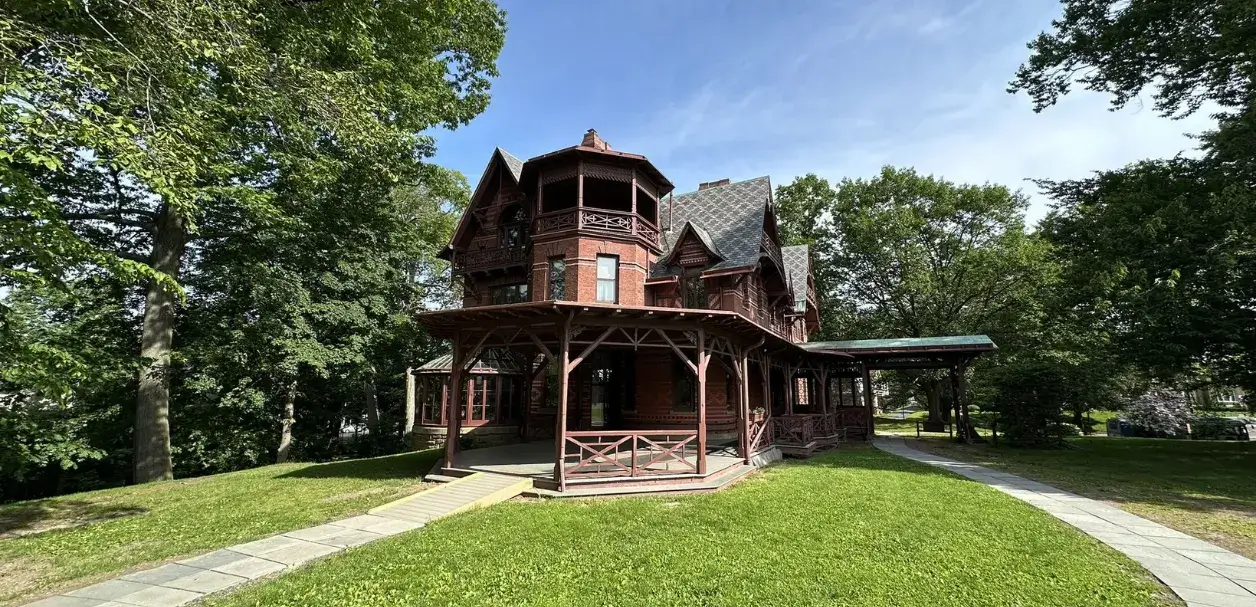
- The Mark Twain House & Museum in Hannibal, Missouri includes the author’s boyhood home, built in the 1840s, and its gardens, as well as an interactive museum with exhibits, films, and more.
- Bonus: If you want to engage in a little virtual literary tourism, you can take an online tour of Quarry Farm, where Mark Twain created his famous characters Tom Sawyer and Huckleberry Finn.
Alice Walker, Sweet People Are Everywhere
- Though she won the Pulitzer Prize for her adult novel The Color Purple, Walker has also penned various children’s works, including the 2021 Sweet People Are Everywhere. The Georgia Writers Museum in Eatonville, Georgia—where Walker grew up—features exhibits about the author, and its website gives a day-trip itinerary for an Alice Walker driving tour to places including her birthplace, the Walker family home, and her school. Interesting tidbit: Walker reportedly engaged in a little literary tourism herself, visiting the former home of writer Flannery O’Connor, who influenced her.
Richard Wright, Black Boy
- The library in Memphis, Tennessee once barred young Richard Wright during segregation, although he found a way to get around the ban, a story told in his 1945 autobiography. Nowadays, the Memphis library gives out the Richard Wright Literary Awards annually.
Places to See Picture Book Art
The Eric Carle Museum of Picture Book Art
- Located in the Five College area of Western Massachusetts, The Eric Carle Museum of Picture Book Art showcases rotating exhibitions of picture book illustrations from around the world in a 40,000 square-foot facility. There’s also a permanent collection with works by Maurice Sendak, Leo Lionni, Rosemary Wells, and others—plus a hands-on art studio for little visitors to make their own art.
- Society of Illustrators’ Annual Exhibit of Children’s Book Art Every year, the Society of Illustrators in New York City puts on an exhibition called “The Original Art” that showcases illustrations from children’s books published in the U.S. during the year.
