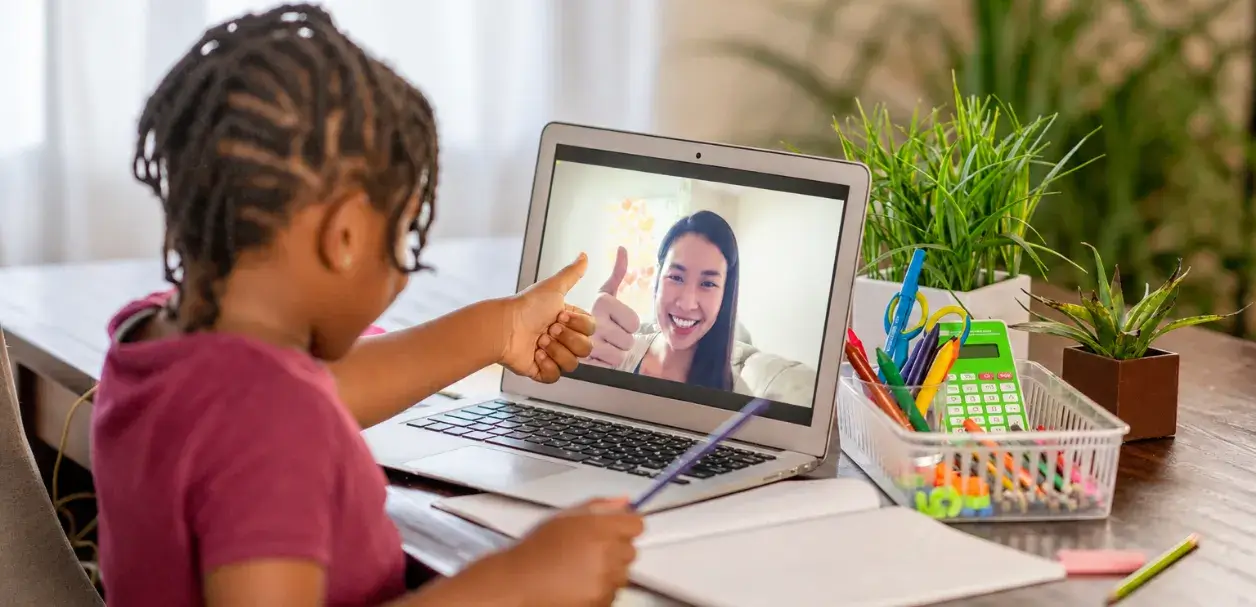
He was smiling from the moment he logged on.
I recently sat in on an elementary schooler’s 25-minute online session with a reading tutor. When the tutor asked the student to tackle a new task, he said, “I got this.” When she put a few sentences together into a short story and asked him to read it in his best smooth voice, he said it again. “I know you do,” she replied.
I expected to watch a lesson. I didn’t expect so much affection on both sides of the screen. If your child needs reading help and you’re wondering whether online tutoring could meet that need, here’s what I saw, and what I’d look for in a tutor.
What Online Reading Tutoring Is and Isn’t
Online reading tutors use a video platform like Zoom to give your child direct lessons designed for their specific needs. The tutor can also respond in the moment to any questions your child raises and anything they misunderstand.
Unlike a reading app or AI tutor that covers similar content, a live human tutor can notice the nuances of a child’s tone and facial expressions as they puzzle through a question. Live tutors can light up when the child gets it right or encourage them when they come up short.
Tutoring is also deeper than mere homework assistance, which may help get one-off assignments done, but doesn’t build knowledge and skills systematically over time. Tutoring is a longer-term commitment that works toward specific learning goals.
The Warmth is Key
Plenty of people could deliver a reading lesson from a script or a timed slide deck. But a substantial part of the magic of tutoring comes from the warmth, enthusiasm, and encouragement the tutor brings, beyond the curriculum.
At one point, the tutor I observed asked the student what he should do when he’s unsure about something he’s read. “Sound out. Try my best.” he answered. “And don’t give up.” It was clearly something they’d talked about before, and it had stuck. What a great lesson for us all.
The tutor ended the session by calling the child by name and telling him she was very proud of him. She was rooting for him in reading, and in life. You could see how much he wanted to meet her expectations and show her what he’d learned. That kind of motivation is hard to manufacture, and it’s a big part of the value that good one-on-one tutoring offers.
Won’t My Child Zone Out on a Screen?
This is the worry I hear most. Kids already get so much screen time that in-person help can seem like the obviously better choice. But in-person tutoring can be more challenging logistically: There’s more choice of tutors and time slots if you’re not restricted to who’s nearby, and most parents can schedule more sessions for their child if they don’t have to get them to a physical location every single time. Plus, online tutoring tends to be less expensive.
Here’s what I saw: The child didn’t sit still, and he didn’t need to. He acted out what he thought words meant. He grabbed books and flyers from his bedroom that related to what they were discussing. He rocked in his chair and sometimes glanced away from the screen. Through all of it, he was engaged, learning, and happy to be in conversation with his tutor.
When he went off on a tangent, she listened. When a sentence featured a character named Nash, he pulled up a roster of his favorite college basketball team and pointed to a player with the same name. Connections like that are learning, too. They tie new words to what a child already knows and make reading feel relevant to life.
If your child can focus for a short stretch, their level of engagement has a lot to do with the specific tutor. The best tutors are patient and flexible about the distractions and digressions that come with any session. And consider the math: A child who meets with a tutor four times a week for 25 minutes gets almost two hours of one-on-one attention. That’s a lot more than a classroom teacher with 25 students can offer.
Research suggests that live online tutoring, done well, can be nearly as effective as in-person tutoring, and that one-on-one sessions tend to do better than small groups. Tutors and school leaders I’ve talked with generally like online tutoring for kids in first grade and up more than for younger kids—kindergartners, who tend to have shorter attention spans and less school experience, may do better in person.
Sounding Out and Understanding
A strong tutor works on the two big ingredients of reading. One is word recognition: “decoding,” which means sounding out words by connecting speech sounds to the letters that spell them. The other is meaning: the knowledge, context, and understanding that help a child make sense of the words they sound out.
The tutor I watched paused often to ask, “What do you think that word means?” or “What’s going on in this story?” Sometimes, the child’s answers missed the mark. When she asked about the word volt, he described a bank vault, a big space filled with money. He’d misheard a vowel sound, but he was thinking hard and reaching for a word he knew. This gave the tutor an opening to get him on the right track in real time, so he could succeed in understanding what he was reading and file the knowledge away for next time.
The exchange wasn’t about testing the student or whether he got the answer right or wrong. It was about learning. The tutor repeated the word, defined it, compared it with what he’d said, and then said it again with emphasis on the vowel sound. Moments like that don’t just correct a misunderstanding that could derail the child’s comprehension of one text. They also keep the conversation going, and that conversation is valuable language learning in its own right.
How to Choose an Online Reading Tutor
Here’s what to look for as you choose a tutor:
- A clear assessment plan. Ask how the tutor decides which skills your child needs to work on. They should be able to explain the tests they use, the evidence behind those tests, and how the results shape the lessons. Ask how often they’ll reassess your child and report progress.
- Real qualifications. Look for a certified teacher or someone trained in teaching reading, plus testimonials or other signs that they get results. Volunteer tutors may be effective as well, but check to see how they were prepared for the role and if they have the support of an expert coach or manager.
- Warmth and connection. Give it a few sessions. It can take time to warm up to someone you’re meeting over the internet. A good tutor conveys warmth from the start and works to capture your child’s attention.
- Variety within each session. The session I observed moved through a syllable warm-up, a demonstration of the day’s spelling pattern, decoding practice, blending syllables into whole words, a fluency drill, dictation, reading sentences and a short paragraph, comprehension questions, and a closing word race. One theme, many ways to practice, and no time to get bored.
- Support for you. A good tutor or program gives parents fun, easy, everyday ideas to complement or reinforce their work. After all, the point of tutoring is that you don’t have to do the heavy lifting on instruction.
What You Need to Get Started
The setup is a light lift:
- A laptop or other device with a webcam
- Reliable high-speed internet
- Pencil and paper for writing practice
- A grown-up to get your child logged on at the right time
Note: If you don’t have high-speed internet or a good device to use, your local library or school district may be able to help you access a device, mobile hot spot, or space to get online for virtual tutoring.
At OpenLiteracy, the program I observed, children meet one-on-one with a state-certified teacher for 25-minute sessions, two to four times a week. That consistency is a real commitment, and in my estimation, it’s well worth it. Online tutoring also saves you the drive to and from a tutoring center and opens up tutors who may not work near you. (I pay OpenLiteracy to tutor students I sponsor. They don’t pay me, and this post isn’t sponsored.)
What It Costs
Private online reading tutoring runs from about $20 to $50 an hour for general help to $100 or more for a specialist trained in structured literacy, which is a step-by-step, explicit way of teaching reading. In-person tutoring tends to cost more, about $30 to $80 an hour, and up to around $160 in some cities.
Free options exist, too. Learn To Be, for example, offers free one-on-one online tutoring from high school and college students. Many school districts and public libraries offer or can refer you to free tutoring programs, as well. Just be sure to vet free programs the same way you would paid ones before you commit your child’s time and effort to them: Ask how tutors are trained, what materials they use, and whether they follow a specific path built around your child’s needs.
Families invest in sports, travel, entertainment, and more. Reading help can be worth an investment, too, and it’s not meant to go on forever. That’s why assessment and a plan matter so much. The goal is to help your child reach grade level and then step back once the extra support is no longer needed.
Imagine that refrain (I got this—I know you do) landing in a final session, and how long a child might carry those words.
Get Reading for Our Lives
Learn how to foster your child’s pre-reading and reading skills easily, affordably, and playfully in the time you’re already spending together.
Get Reading for Our Lives