A mom I know recently told me about watching her eighth-grade son on FaceTime, helping a friend prep for a school presentation.
The two boys were partners tasked with delivering a written report to their class. But the friend couldn’t read it—couldn’t read much of anything, really—so instead, her son was patiently helping him memorize the key points.
She was proud of her son’s kindness, but absolutely heartbroken about his friend.
Her son had struggled too. For years, an individual education plan (IEP) had given him structured support to catch up to grade-level reading this year, on the cusp of high school. Two caring, knowledgeable teachers and a mother who advocated relentlessly made all the difference.
His friend never got that. It’s tempting to chalk it up to learning disabilities or bad luck. But it’s really a story about what happens when kids don’t receive the right reading instruction early and what becomes possible when they do.
The good news: you don’t have to leave this to chance. Here’s what the research says about how children learn to read, and what to look for in your child’s classroom.
How Reading Actually Works
The ability to read comes from the combination of multiple skills.
Some of those skills grow naturally through spoken language. Conversation, storytelling, and shared experiences help children build vocabulary and background knowledge that lets them understand what they eventually read.
Other skills are different. They’re specific to written language and the “alphabetic code”: the system of written letters that represent spoken sounds. These skills don’t grow naturally through daily life. We have to teach them.
As children approach school age, they need to be taught the alphabetic code—the relationships between speech sounds and their spellings. This can get a little complicated, because English has 44 sounds but only 26 letters to represent them. This means that some letters represent multiple sounds and many sounds have multiple spellings that use one, two, three, or even four letters (Think: go, show, woe, though).
How Parents Can Help Before Kindergarten
You can point out letters in everyday life and talk about their shapes. Specifically pointing out and describing the lines, curves, and dots that make up each individual letter helps kids distinguish between them. An N and an M are similar, but when you point out the lines and trace them, the difference is clearer.
You can also help children notice that spoken words are made up of parts—syllables and individual sounds like their starting sound, middle sounds, and ending sounds.
Kids pick all this up gradually. They can typically notice syllables first—if you start pointing them out—and then start being able to distinguish beginning sounds, then ending sounds, and eventually all the sounds within words. This helps explain why children who are learning their letters may at first try spelling a word by writing just its starting letter.
Once children understand that words are made of individual sounds, they can begin connecting those sounds to letters (and letter combinations) in print.
As they get older, this understanding grows through both experience and specific instruction. They learn that certain letter patterns tend to go together in English, while some combinations rarely appear. They discover that word endings like -s, -es, and -ed carry meaning—such as plural or past tense.
Spelling is not random, even though it can often feel that way. Just 4% of English words are truly irregular. The specific way words are written has to do with patterns of sound, meaning, and history that can be taught and learned.
Some kids pick up these patterns on their own, figuring out, for instance, that the spelling ough is pronounced differently in borough and through. But most children learn these patterns faster and better when someone directly teaches them.
Imagine going to another country where you don’t know the language—and it’s written in a different alphabet. If you stayed long enough, you would surely learn to communicate and pick up critical information on signs or menus. But you would get there a lot faster if someone offered you a phrasebook that directly taught you the most common words and expressions you’d need in the language you already understand.
Where Schools Come In
Once children enter kindergarten, schools need to focus on helping them master this alphabetic system. This is where phonics instruction becomes essential.
Phonics refers to the relationship between speech sounds and written letters. It teaches children how to map one onto the other. In the above analogy, it’s the “phrasebook” for written English—the guide that connects what you know to what you don’t.
In English, for example, the long A sound can be spelled ay, ey, eigh, and several other ways. But it cannot be spelled kt, for example.
Phonics is both knowledge of the alphabetic code and a strategy for reading unfamiliar words—it’s what lets kids “sound out” new words.
A phonics-based approach teaches children to look carefully at each letter or letter combination, connect the letter or letters to a sound, and then blend the sounds of a word together.
This differs from less-reliable reading strategies like guessing based on pictures, guessing from the first letter, or memorizing word shapes.
Decades of research show that phonics is the most effective way to help most children learn to read. This may sound obvious, but it has been the subject of serious debate—and many schools do not have systematic phonics instruction or phonics-trained teachers, despite overwhelming evidence of its value.
What Effective Phonics Instruction Looks Like
Strong phonics instruction is explicit: It teaches children directly how the code works. It’s systematic, meaning skills are taught in a logical order. And it’s cumulative, so new learning builds on what came before.
You’ll know instruction is direct when you observe the teacher:
- Tell students the purpose of the day’s lesson. (E.g., “Today we’re going to learn about the long E sound.”)
- Show kids specific sound-spelling correspondences with examples. (E.g., “The sound /ē/ can be spelled “ee” like in feet or tree.”)
- Supervise the kids’ practice and offer immediate corrections when needed.
- Have kids practice alone only after showing them what to do and observing them do it.
This kind of direct phonics instruction is in sharp contrast to other approaches where the student leads, does a lot of self-directed activities, or reads silently. None of those things is wrong in themselves, but students need strong phonics understanding before they work and learn well independently.
This point is critically important. We shouldn’t expect young students to teach themselves.
When teachers do give students texts to try to read independently, the texts need to be “decodable.” That means they must contain phonics patterns that the kids have learned. They cannot be just “reading-level texts” that aren’t directly tied to the phonics lessons kids have been getting.
The direct phonics instruction approach gives kids a fair shot at using what they’ve been taught to successfully read. Other approaches leave many kids staring blankly at incomprehensible texts and making little reading progress from year to year.
Research from the U.S., U.K., and Australia has consistently shown that systematic phonics instruction greatly improves English reading outcomes.
Why Isn’t Phonics Instruction Universal?
Many teachers were not trained this way. Others may view phonics as dry or overly technical, or not really understand it themselves.
And the system has depth and layers, it’s true. English uses 26 letters, about 44 speech sounds, and more than 200 spelling patterns. But with proper training and a strong curriculum, this complexity is absolutely manageable. It’s not rocket science. It’s simply a code with nuances that generations of teachers and students have mastered.
Fixing how teachers are trained is a long-term project, and it’s not something you can solve from your child’s classroom. What you can do is know what good instruction looks like—and ask for it.
What Parents Should Look For
If your child is not yet a fluent reader, check that their school and teachers will provide direct, well-sequenced phonics instruction.
You can learn a lot by asking simple questions:
- What curriculum do you use?
- What phonics scope and sequence do you follow?
- Are children assigned decodable books?
- How much time do you spend on phoneme awareness?
- How much time do you spend on phonics?
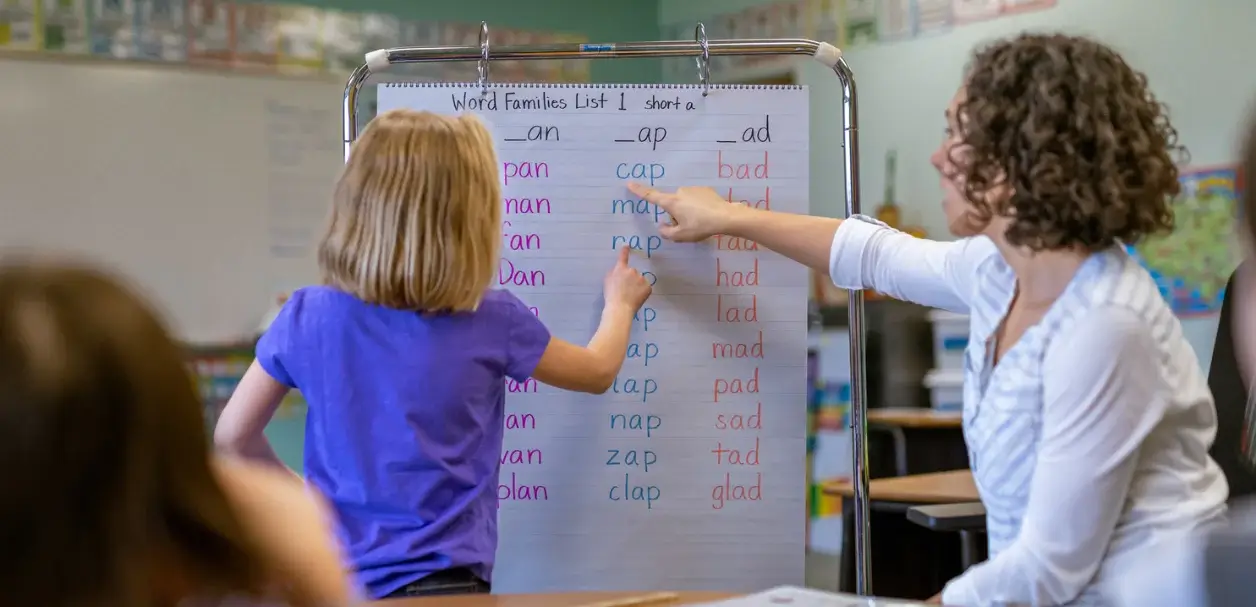
You can also observe. In a strong early-reading classroom, you’re likely to see teachers helping children work on manipulating sounds inside words to build more understanding. For example, a teacher may tell them: “Say mat. Now change the /m/ to /b/. That’s right. It makes bat.”
Expert teachers implementing a strong phonics curriculum may also have students use mirrors to watch how their mouths form sounds. They may encourage kids to feel their throats to notice the vibration or place their hands in front of their mouths to detect puffs of air when they speak. Attention to these physical nuances in how sounds are articulated is extremely beneficial for kids who are struggling to discern similar sounds within words, which affects reading and spelling.
Activities like these show that the teacher understands that reading begins with hearing and producing the sounds inside words. Such hands-on lessons may be rarer than forms of phonics instruction that teach sounds but not how they are made, but they are a sure sign of good instruction.
You’ll also want to watch for whether the teacher provides immediate feedback when students make a reading mistake and directs them to pay attention to the letters within the words, even when spellings are irregular.
This kind of instruction is especially important for multilingual learners, children who speak different dialects, and struggling readers. However, it benefits all students, helping them all become the thriving readers they deserve to be—and that our society needs them to be.
Get Reading for Our Lives: The Urgency of Early Literacy and the Action Plan to Help Your Child
Learn how to foster your child’s pre-reading and reading skills easily, affordably, and playfully in the time you’re already spending together.
Get Reading for Our Lives