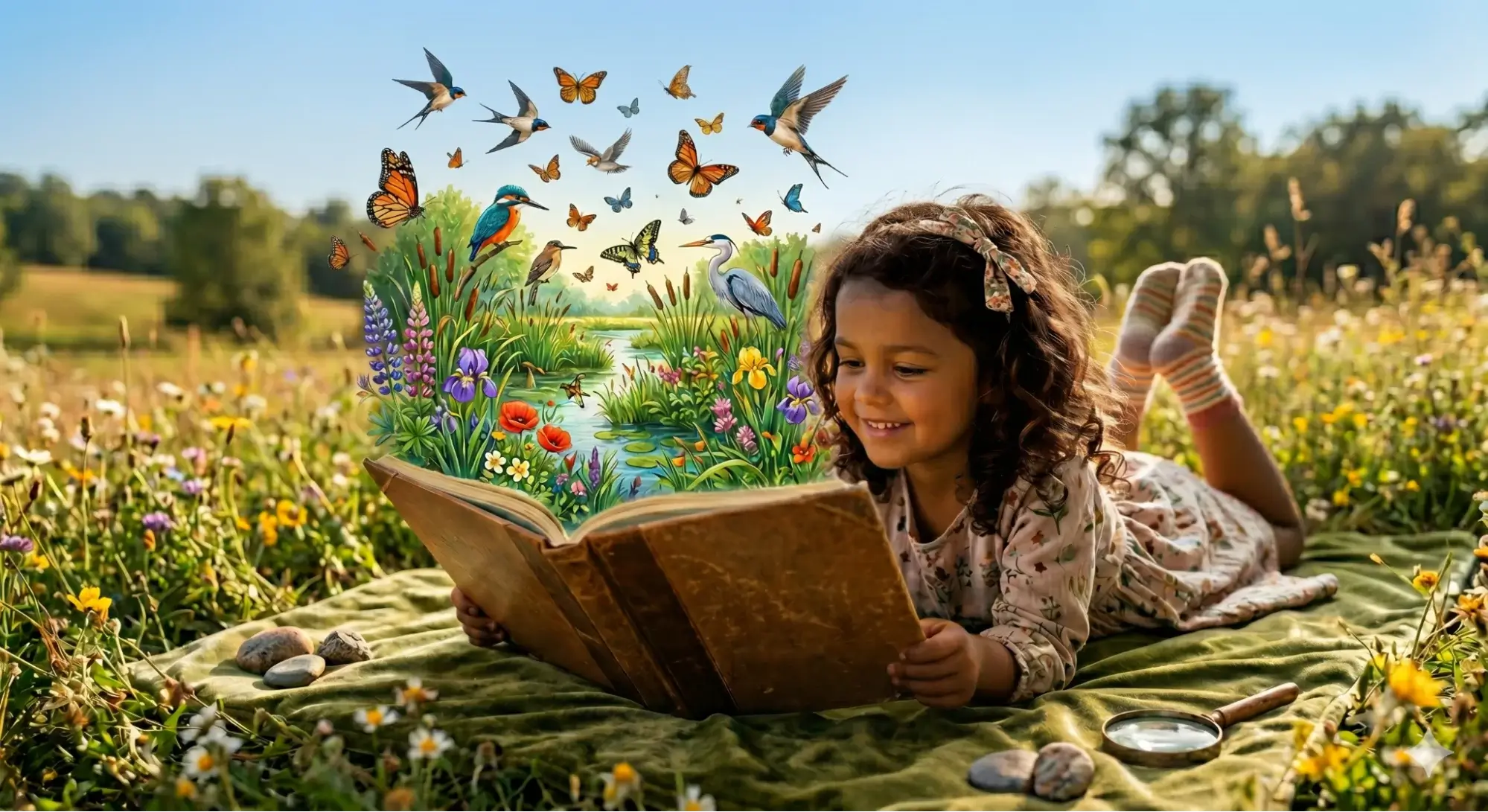
In the 1800s, a legendary swamp teemed with vining plants, warbling songbirds, and colorful butterflies in eastern Indiana—before it was drained, razed, tapped for oil and timber, and turned into dry, flat farmland as far as the eye could see.
But still the swamp, intriguingly named the “Limberlost,” lived on in the imagination of people who never knew it in real life. Even when no one remained with personal experience of it, the Limberlost persisted in the minds of those who had read about it in popular fiction.
That was thanks to numerous runaway best-sellers penned in the early 1900s by a woman who flaunted the conventions of her world to become a working woman—a daring nature reporter and wildly popular novelist. Named Gene Stratton-Porter, she tramped through the swamp in boots and (scandalously) pants, camera slung around her neck.
Stratton-Porter meticulously documented the wildlife of the lush habitat she loved and could see dwindling away before her. She published extensive nonfiction nature studies of the area—plus megahit novels that drew in generations of readers despite being largely forgotten today.
Young-adult and middle-grade novels like Freckles, A Girl of the Limberlost, and many others told touching, uplifting fictional tales set against the backdrop of the Limberlost’s pristine wilderness. Many were also made into films at the dawn of the movie era.
Stratton-Porter evoked the beauty of the swamp and the life it harbored like a kind of Garden of Eden, with an articulate affection that managed to stir an aching longing in those who never saw it. Ahead of her time, she also predicted the drought and climate changes that would come from draining wetlands and cutting forests.
Her portrayal kept the Limberlost alive in legend—and then, amazingly, helped bring it back in reality.
Many decades after she and her beloved swamp were both gone, and a century after she first wrote about it, Stratton-Porter’s words inspired an incredible rebirth of the Limberlost.
Moved by her books, a small group of people worked to buy and rehabilitate a stretch of the former wetlands. They drew inspiration from the author’s detailed descriptions of the lost wilderness to slowly restore the wetlands and coax back the vanishing species that once thrived there.
Today, visitors can explore the Loblolly Marsh and Limberlost nature preserves to see some 1,500 acres of recovered wilderness once again bursting with life, achieving a level of biodiversity that had seemed forever lost. (The Loblolly Marsh, so-named for a Miami Native American word, was the first preserve reclaimed by a few Stratton-Porter fans.)
It’s a tale of hope that illustrates how powerful fiction can be when it touches hearts—and how much impact individuals can have when their hearts are touched. It offers a valuable lesson in leveraging the empathy learned through stories into action in the real world. To me, it also underscores the value of exposing children to myriad works of fiction from across diverse places, times, cultures, perspectives, and traditions.
The Girl of the Limberlost was a favorite of my own grandmother, though I don’t recall ever reading it as a child. My kids never got to know their great-grandmother, but they know something of her through family stories, a hodge-podge of rickety belongings passed down somewhat haphazardly, old sepia-toned photos, and a few equally sepia-tinged books.
When my kids were small, we read a few old novels that took place in the small Florida community my grandmother spent many years in. It was only natural that one day we would get around to Stratton-Porter’s nearly forgotten classic, too. By the time I acquired an age-spotted copy of A Girl of the Limberlost, though, only my youngest was interested in sitting down to listen—but she was enthralled.
The story opens on a misunderstood girl who goes off to school in the city, only to be mocked mercilessly for her poor, unfashionable clothing. It’s a sentimental tale of underdog triumph and emotional redemption with the kind of timeless appeal that speaks to children with a deep sense of justice (and injustice). It went straight to my young daughter’s heart, despite its antiquated language.
And so, this third-hand book recommendation from a long-gone great-grandmother resurfaced, after skipping a couple of generations, and briefly transported my child out of her place in time, into another world. Someday, she may pass along the recommendation and keep these memories alive a little longer.
Be that as it may, though, I like to think that either way she’ll remember the real-world story: That a small group of people—rather than succumbing to nostalgia or fatalism in reading about a beautiful world destroyed by human folly—took matters into their own hands and made their world a little better.
Most of all, I hope that she may take the lesson of the recovered Limberlost and let it inspire her. That she’ll carry it with her, a reminder to do her own part to help raze what’s not right, plant the seeds of what should be, and forge a future that’s as bright and beautiful as the best worlds in books.
Get Reading for Our Lives
Learn how to foster your child’s pre-reading and reading skills easily, affordably, and playfully in the time you’re already spending together.
Get Reading for Our Lives