
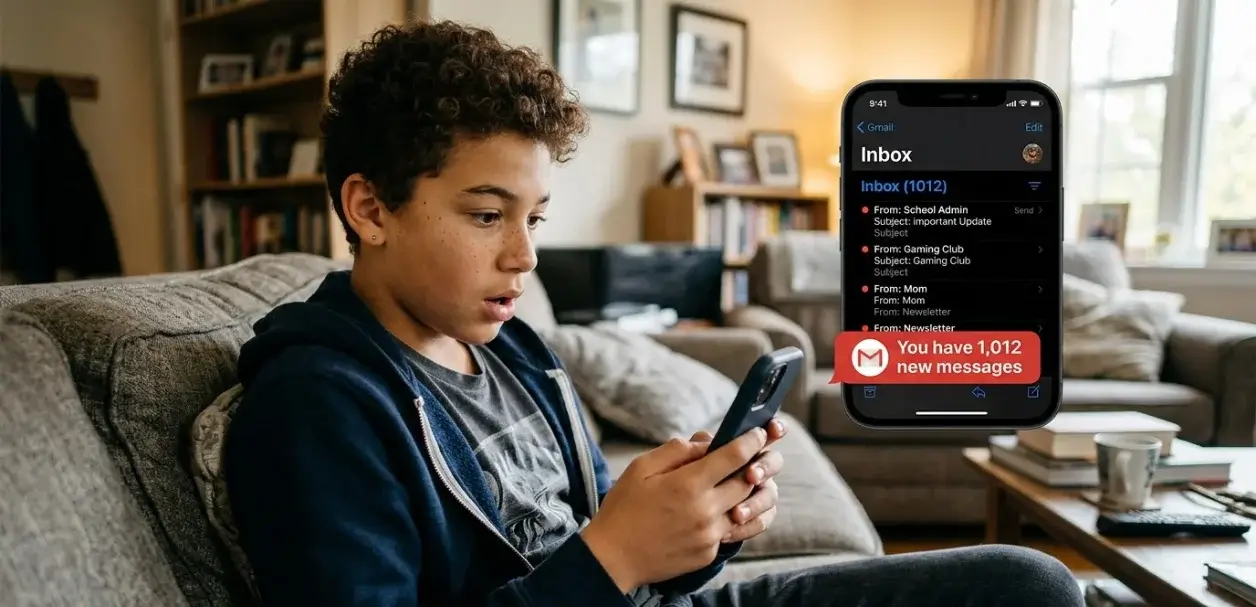
The other day, it became clear to me that my 17-year-old doesn’t read his emails.
That is, he sees the notifications as emails come in, and he reads the subject lines for key points. He does his best to read the important messages. But he certainly doesn’t read them all.
He’s a senior in high school, and it’s vitally important for him to check regularly for emails from colleges with updates on his applications—as well as emails from teachers about assignments, from counselors about college and graduation to-dos, from school administrators about extracurriculars, and from countless others about scholarships, jobs, and other opportunities.
In other words, he can easily miss crucial information and drop balls if he doesn’t read all his emails. Feeling a little panicked, I suggested that we go through his email systematically together and respond to, archive, or delete each one.
He declined, despite being a gifted and hard-working student.
His reasoning was that he gets well over 100 emails a day, and has for years. He was a little rattled when I explained that his email will eventually run out of space—but not enough to be willing to dig into the mound of digital correspondence that’s been piling up on him, unbeknownst to me, for almost a decade.
When I mentioned this to my youngest, who’d just turned 12, she agreed that even at that age she’s getting a nearly unmanageable amount of email. She shared that she only learned how to access her school email account this year, in sixth grade, and immediately discovered she had emails from teachers going back to years earlier. The earliest messages, from when she was nine, were likely automated Google classroom messages, but what nine-year-old can distinguish the spam (or spam-adjacent) from the rest?
Once she realized, my daughter said, she started spending 45 minutes a day deleting emails, so they wouldn’t pile up. I repeat—my sixth grader was spending 45 minutes a day on screens just to delete emails. Not doing homework. Not reading books. Not spending time outside, socializing, playing sports, or doing chores. Just going through emails that include copious alerts from various platforms her educators have used, interspersed with a handful of meaningful communications. The opportunity costs are huge, and they’ll only increase as she gets older.
All this got me thinking about the digital overload on kids and teens. It’s massive, and it reveals an important contradiction in how we adults are interacting with young people. We want tweens and teens to spend less time on screens—but then we expect them to do most of their schoolwork and studying on screens, complete driver’s ed and digital trainings on screens, and read and process hundreds of long emails every week.
If we as a society really care about the intense harms that come from too much time on technology and too little time in nature and society (harms experts suspect are drowning young people in depression and anxiety as never before), it’s time to walk the walk.
As parents, we can advocate for more reasonable limits and policies from schools and technology companies. We can also help our kids learn to manage email overload. Unsubscribing from newsletters, setting up automatic filters, and organizing their inboxes can help them get a handle on their email before it gets the better of them.
It can’t all be up to our kids, though. Caring adults also need to push for reasonable limits. When teachers want to use a digital platform to teach, assess, or assign work to their students, we shouldn’t automatically allow those companies to email our kids day and night. The fact that there are digital textbooks or e-books available doesn’t always mean they’re the best option.
And just because it’s easy to blast out emails to youngsters about everything under the sun, it doesn’t mean we should. A couple of weeks after our conversation, my daughter told me her school district was turning off student email because there was so much spam. That may be the nuclear option, but it reminds us that there’s a choice and policies can always change.
Parents got a taste of the educational digital overload during Covid, when so many of us across America floundered under constant emails that our children were missing impossible numbers of Google classroom assignments.
If we want to reduce the digital overload on kids, we can ask educational technology companies to protect kids with reasonable limits (including stopping the barrage of unnecessary emails and notifications) and we can ask our kids’ schools to set reasonable policies, too. Obviously, some technology-based learning can be a good thing and some email communications are necessary and helpful. The rest can be communicated as it was for generations—face to face.
Get Reading for Our Lives: The Urgency of Early Literacy and the Action Plan to Help Your Child
Learn how to foster your child’s pre-reading and reading skills easily, affordably, and playfully in the time you’re already spending together.
Get Reading for Our Lives