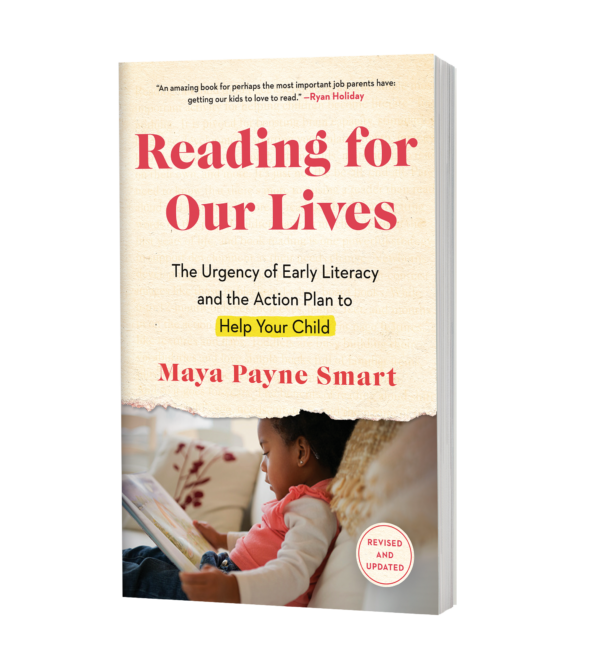

We’ve all heard the advice: “Read to your child every night.” It’s a beautiful ritual for bonding, building your child’s vocabulary, and deepening your relationship. However, it ignores a key truth I realized while researching my book, Reading for Our Lives: most kids are looking at the illustrations, not the words.
While kids are soaking in the story, they might not actually realize that the magic is coming from the print on the page. Bringing focus to the words on the page helps children build the print awareness they need to move from simply listening to stories to actually reading words on their own. And it misses a golden opportunity to build literacy and reading skills alongside their love of the stories told in books.
The good news is that you don’t have to change your routine or find extra hours in the day to bridge this gap. Keep the bedtime story for the bonding and story love (or a morning story time for those, like me, who are exhausted by bedtime), but add 60 seconds of literacy practice to build up some key skills that will set up your child for reading success.
To raise a child who truly masters reading, we have to be deliberate about bringing their attention to written language, the sounds that make up words, and how the two connect. Here are three simple tweaks to your story time that can shift your read-aloud time from a passive listening experience for your child to an active literacy lesson:
1. The Power of the Finger-Point
It sounds almost too simple, but dragging your finger along text you read is a game-changer. This small gesture teaches a child that the story comes from the print, not just the art.
It also helps them understand that English text flows from left to right and from the top of the page down. By following your finger, your child can begin to see exactly which black marks on the page hold the sounds of the story.
This “print awareness” is a key early step to unlocking the secrets of reading for your child. The sooner they understand that these marks are a code representing words, the sooner (and easier) they can start to learn the code itself.
Then take it up a notch by tracing your finger along a specific letter, like this:
2. Teach and Trace Letters
You don’t need a classroom or a special curriculum to teach letters. Just use a modified version of the finger point. Point out a letter and give a quick explanation. Tell its name, the sound it makes, and describe its shape as you trace it with your finger.
When my daughter Zora was small, I taught her how to write her name, but I didn’t realize at first that she didn’t know those symbols she’d memorized represented specific sounds.
Spend just 30 seconds talking about the lines, dots, and curves that make up a letter like Z. Just say something like: This is Z. It makes /z/ like in Zora. It has a short line across, then a line that goes down and sideways, then another short line across. After you trace it with your finger, invite your child to do the same.
This alphabet knowledge makes the eventual road to reading so much easier. You can also do this kind of lesson anytime, anyplace. After all, your kitchen and neighborhood are full of letters. Just point them out on cereal boxes, graphic t-shirts, or street signs and give a 15-second lesson whenever you think of it.
3. Discuss Sounds During Story Time
Literacy actually starts with the ears. Before a child can map a sound to a letter, they have to be able to discern sounds within words—a skill called phonological awareness.
You can build this during your regular reading time by pausing briefly to play with the words on the page.
- Identify starting sounds: Point to a word and discuss the initial sound: Look, cat starts with the /k/ sound.
- Clap out the syllables: Choose a word with two or more syllables, then demonstrate clapping it out to hear the parts of the word. Share that these parts are called syllables.
- Play with rhymes: In rhyming books, point out the rhyming words to help your child hear how changing just the starting sound creates a brand-new word.
- Emphasize alliteration: Point out sentences that use the same starting sound, like “Peter Piper picked a peck of pickled peppers.” Highlight the sound and tie it to the letter.
Build Literacy in 60 Seconds a Day
Making any of these tweaks can turn even a short story time into a literacy learning powerhouse. Just keep it to a minimum—I’m not kidding when I say that 60 seconds can do it. You want to keep the emphasis on the story, bonding, and reading joy.
Along the way, these tiny, deliberate shifts in your daily routine can open the door to easier, more enjoyable reading for your child, and all the success in school, communication, and life that comes along with it.
Host a Virtual Book Club
Want to dig deeper into early literacy and family literacy? Consider hosting a virtual book club where we explore these ideas together.
Learn more.